
Bearing problems rarely appear without any warning. In forestry equipment, unusual noise, increasing vibration, abnormal heat, or changes in lubricant condition can all point to a developing issue. Recognizing these signs early gives operators and maintenance teams a chance to investigate the cause before a bearing failure leads to an unexpected machine stoppage.
Because forestry machines work in mud, dust, water, debris, and under constantly changing loads, bearing condition should be part of routine inspections rather than something checked only after a problem appears.
Recognizing early warning signs
A bearing that is beginning to deteriorate can show several different symptoms. No single sign is enough to confirm a failure, but changes from the machine’s normal operating condition deserve attention.
Unusual or changing noise
Noise is often one of the easiest changes for an experienced operator to notice. A healthy bearing normally produces a relatively consistent sound appropriate to the machine and operating conditions.
Grinding, rumbling, clicking, squealing, or knocking can indicate bearing damage, contamination, lubrication problems, misalignment, or another mechanical fault. A noise that becomes louder with speed or changes when the machine is under load is particularly worth investigating.
Operators should pay attention to changes from the machine’s usual sound, rather than relying on one specific noise as proof of bearing failure.
Increasing vibration
Changes in vibration can also provide an early indication of developing bearing or rotating-component problems. Excessive vibration may result from bearing wear, imbalance, misalignment, looseness, contamination, or damage elsewhere in the drivetrain.
Experienced operators may notice unusual movement through the machine or controls, but vibration monitoring equipment can detect changes that are difficult to identify by hand.
For critical forestry equipment, techniques such as vibration analysis can help maintenance teams establish a baseline and identify developing problems. More advanced analysis methods can detect changes in the vibration signature associated with bearing defects, although interpretation should be carried out using appropriate equipment and expertise.
Abnormal heat
Temperature is another useful condition indicator. A bearing that consistently operates hotter than its established normal range may be experiencing excessive friction, insufficient or unsuitable lubrication, contamination, excessive loading, misalignment, or another mechanical problem.
The important point is change from the normal operating temperature for that specific machine and bearing. There is no single temperature threshold that applies to every forestry application.
Thermal cameras can make these changes easier to identify during inspections, particularly when several similar bearings can be compared under comparable operating conditions.
Heat can also accelerate lubricant degradation, which may then increase friction and create a cycle of further heating and wear. If a bearing housing develops an unexplained hotspot, investigate the cause rather than simply adding more grease.
Lubricant leaks or contaminated grease
Lubricant condition can provide valuable clues during a walkaround inspection.
Look for:
- Grease leaking around seals or bearing housings
- Oil escaping from a lubricated assembly
- Grease containing visible dirt, metal particles, or water
- Unusual changes in grease consistency or appearance
- Burnt or overheated lubricant
- Damaged, loose, or deteriorated seals
Contamination is particularly important in forestry environments. Mud, water, dust, sawdust, and plant debris can enter a bearing when seals or protective components are damaged.
Where applicable, lubricant sampling and laboratory analysis can provide much more reliable information about contamination and wear than visual inspection alone.
Monitoring tools
Depending on the machine and the criticality of the bearing, maintenance teams may use:
- Vibration monitoring
- Thermal imaging
- Ultrasonic inspection
- Lubricant or oil analysis
- Visual and tactile inspections
- Maintenance and condition-monitoring records
The most useful approach is usually a combination of routine inspections and condition monitoring, rather than relying on one measurement in isolation.
Understanding the root causes of bearing failure
Identifying a failed bearing is only part of the job. If the underlying cause is not corrected, a replacement bearing may fail again.
Lubrication problems
Lubrication is fundamental to bearing life, but the correct approach depends on the bearing design, lubricant, operating conditions, and manufacturer’s recommendations.
Under-lubrication can increase friction, heat, and surface wear. However, over-lubrication can also create problems, particularly where excess grease increases resistance and operating temperature.
In forestry applications, the challenge is greater because water, dirt, and debris can compromise lubricant condition and seals. Lubrication schedules should therefore be based on the equipment manufacturer’s recommendations and the actual operating environment.
Simply adding more grease is not always the right response to an overheating bearing.
Misalignment
Shaft, housing, and bearing alignment have a direct influence on how loads are distributed through the bearing.
Misalignment can create uneven loading and abnormal contact patterns. Over time, this may produce premature wear, pitting, overheating, or vibration.
If the same bearing repeatedly fails in the same location, replacing the bearing alone may not solve the problem. The shaft, housing, mounting arrangement, alignment, and surrounding components should also be investigated.
Excessive loads and shock loading
Forestry machinery can experience rapidly changing loads, impacts, and vibration. Bearings must operate within the limits specified for their particular application.
Excessive radial or axial loading, high rotational speeds, repeated shock loads, or an unsuitable bearing selection can shorten service life.
Rather than relying on generic lifespan figures, maintenance teams should refer to the bearing manufacturer’s load ratings and the machine manufacturer’s specifications. Actual service life depends on the bearing, load spectrum, speed, lubrication, contamination, alignment, installation quality, and operating environment.
Incorrect installation
A new bearing can be damaged before the machine even returns to work if it is installed incorrectly.
Common installation problems include:
- Applying force through the wrong bearing ring
- Using unsuitable tools
- Damaging seals or shields
- Incorrect fits between the shaft and housing
- Contaminating the bearing during installation
- Failing to follow the manufacturer’s mounting procedure
Improper fits can also allow unwanted movement between components, creating additional wear and contamination pathways.
Installation should therefore be treated as a precision maintenance task, not simply a component replacement.
Contamination
Dirt and water are major concerns in forestry environments. Abrasive particles can damage rolling surfaces, while moisture can promote corrosion and degrade lubricant performance.
Damaged seals, cracked covers, poor cleaning practices, or exposed components can all increase the risk of contamination.
Keeping replacement bearings sealed in their original packaging until installation, using clean tools, and inspecting seals regularly can significantly reduce unnecessary contamination.
Electrical erosion
Electrical erosion is a more specialized failure mechanism and is mainly relevant to electrically driven equipment where stray currents can pass through a bearing.
Electrical discharge can create small pits or fluting patterns on bearing surfaces. Over time, these defects can contribute to increased noise, vibration, and premature failure.
Where electrically driven forestry equipment shows unexplained bearing problems, electrical causes should be considered alongside mechanical and lubrication issues.
Differentiating normal and abnormal operation
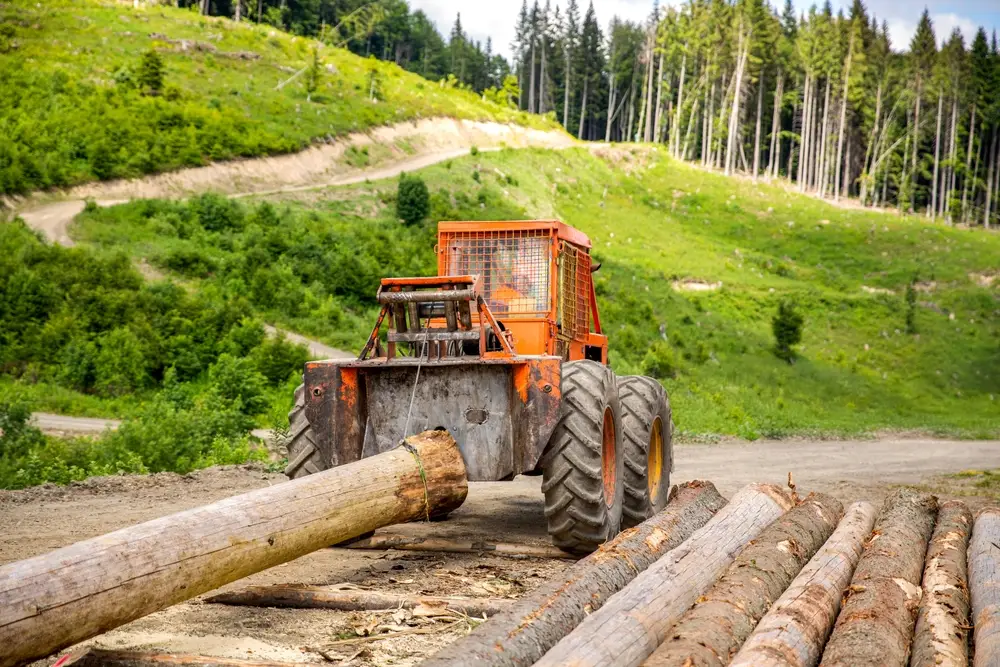
Forestry equipment does not operate in a perfectly quiet or vibration-free environment. Engines, hydraulic systems, cutting attachments, tracks, and other moving components all generate noise and vibration.
The goal is therefore not to eliminate every sound or temperature change. It is to recognize changes from the machine’s established normal condition.
Noise
A consistent, familiar operating sound is generally less concerning than a new grinding, clicking, rumbling, or repetitive knocking noise.
A noise that changes with rotational speed or load can provide useful diagnostic information, but other components can produce similar symptoms. A bearing should not be condemned based on sound alone.
Temperature
Temperature should be assessed in relation to the bearing’s normal operating condition and the manufacturer’s specifications.
A rapid increase, a new hotspot compared with similar components, or heat accompanied by unusual noise or vibration warrants investigation.
Discoloration, a burnt lubricant smell, or obvious signs of overheating are additional reasons to stop and inspect the assembly safely.
Wear patterns
When a bearing is removed for inspection, its wear pattern can help identify the cause of failure.
Uneven wear, pitting, flaking, corrosion, discoloration, or damage concentrated on one area may indicate problems involving loading, alignment, contamination, lubrication, or installation.
Repeated failure at the same position is particularly important. It may indicate a problem with the surrounding system rather than with the replacement bearing itself.
Bearing inspection checklist
During routine inspections, operators and technicians can look for:
- New or increasingly loud mechanical noises
- Changes in vibration
- Unusual heat around bearing housings
- Damaged or leaking seals
- Contaminated or degraded lubricant
- Unusual movement or looseness
- Visible corrosion, wear, or damage
- Repeated bearing failures in the same location
Recording these observations can be surprisingly useful. A simple maintenance log showing when noise, temperature, vibration, lubrication, or bearing changes occur can reveal trends that are difficult to identify from memory alone.
The Impact of environmental conditions
Forestry equipment operates in some of the most demanding environments for mechanical components. Mud, water, dust, wood debris, temperature changes, and pressure washing can all affect bearing performance.
Water, mud, and abrasive contamination
Water can enter through damaged or unsuitable seals and compromise the lubricant. Abrasive particles can then accelerate wear on rolling elements and raceways.
In wet environments, corrosion is another concern. Even relatively small areas of corrosion can develop into surface damage that affects smooth bearing operation.
This is why seal condition and cleaning practices matter just as much as the bearing itself.
Temperature changes
Cold conditions can increase lubricant viscosity, while high temperatures can change lubricant behavior and accelerate degradation. Rapid temperature changes may also contribute to condensation in some operating or storage environments.
The correct lubricant and maintenance procedure should therefore be selected according to the bearing, machine, climate, and manufacturer’s recommendations rather than a universal temperature rule.
Storage and handling
Bearings can be damaged before installation through poor storage or handling.
Replacement bearings should generally remain in their original packaging until they are needed and should be stored in a clean, dry environment. Dropping a bearing, contaminating it with dirty tools, or exposing it unnecessarily to moisture can introduce problems that only become apparent after installation.
Clean handling is especially important for precision bearing components.
Seals and shields: the first line of protection
Seals and shields help protect bearings from the contaminants encountered in forestry work. Their design and level of protection vary considerably.
| Protection Type | General Characteristics | Typical Consideration |
| Metal shield | Reduces entry of larger particles with relatively low contact resistance | Cleaner or less demanding environments |
| Contact seal | Provides stronger protection against water and contaminants | Wet, muddy, or contaminated applications |
| Non-contact seal | Offers protection with less sealing contact and friction | Applications where speed and contamination levels permit |
| Labyrinth seal | Uses a tortuous path to limit contaminant entry | Applications exposed to demanding dust or debris conditions |
The appropriate arrangement depends on the bearing design and application. A seal should not be selected solely because it appears more protective; friction, speed, temperature, lubrication, and maintenance requirements also matter.
Inspect seals regularly for cuts, cracking, deformation, looseness, or other damage.
A Practical approach to bearing condition monitoring
Early detection is most effective when it becomes part of normal maintenance rather than an occasional reaction to a breakdown.
A practical routine can include:
- Listen for changes in normal operating noise.
- Observe bearing housings, seals, and surrounding components during walkarounds.
- Check for unusual temperature or visible lubricant problems.
- Monitor vibration on critical rotating equipment when appropriate.
- Document recurring symptoms and bearing replacements.
- Investigate the cause when a bearing fails prematurely.
- Follow manufacturer specifications for lubrication, installation, inspection, and replacement.
If a bearing shows significant overheating, severe noise, excessive movement, visible damage, or another serious abnormality, the equipment should be made safe and inspected before continued operation. Do not rely on a visual check alone when the condition of a critical component is uncertain.
Bearing failures are often the result of several factors rather than one isolated event. Good lubrication practices, clean installation, effective sealing, correct alignment, appropriate loading, and regular condition monitoring can all contribute to longer and more predictable bearing service life.
For forestry operators, the most valuable habit is simple: know what normal looks, sounds, and feels like for your machine, then investigate meaningful changes early.